If you are trying to work out what “Marketing Cloud” actually means at Salesforce, you have probably already run into a dozen different acronyms: MCE, MCAE, MCN, MCP, MCI, UMA, Agentforce Marketing. These names change regularly, and the product people called “Marketing Cloud” ten years ago has very little in common with what carries that name today.
This guide has one purpose: to give you a clear picture of the Salesforce marketing ecosystem in 2026, without the sales pitch, so you know exactly what someone means when they mention one of these products.
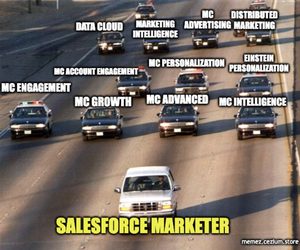
Agentforce Marketing, the new umbrella brand
Since late 2025, Salesforce has grouped all of its marketing solutions under a single banner: Agentforce Marketing. It is not a product in itself, but a collective name covering both the legacy tools (such as Marketing Cloud Engagement) and the newer products built around agentic artificial intelligence.
In practice, if you use any Salesforce marketing tool today, old or new, you are considered an Agentforce Marketing customer. Think of it as a family name that brings together several products, each with its own identity.
Under that umbrella sit three main families of tools:
- marketing automation platforms (Marketing Cloud Engagement, Marketing Cloud Account Engagement, Marketing Cloud Next)
- real-time personalization platforms (Marketing Cloud Personalization)
- marketing intelligence platforms (Marketing Cloud Intelligence, Salesforce Marketing Intelligence)
Salesforce also sells other tools aimed at marketing teams, such as loyalty and offer management, but those are separate products that are not part of Marketing Cloud. This guide focuses on the six products above.
The three marketing automation platforms
This is where most of the confusion sits, and probably why you landed on this page. Salesforce currently offers three distinct marketing automation solutions, each inherited from a different history.
Marketing Cloud Engagement (MCE), the established one
Formerly known as: ExactTarget, then simply “Marketing Cloud”
Marketing Cloud Engagement is the oldest and most mature product in the portfolio. Acquired by Salesforce in 2013 under the ExactTarget name, it is built for large enterprises and complex B2C requirements.
Its main strength is flexibility. MCE can run on its own, without necessarily being connected to a Salesforce CRM, and it lets you build highly sophisticated customer journeys using languages such as AMPscript and SSJS. That power comes at a price: getting the most out of it requires real technical skill, and a solid implementation usually needs a team combining marketers, developers and administrators.
MCE remains the default choice for organisations with advanced personalisation needs and an existing technical setup. Salesforce continues to maintain it and has introduced an “MCE Plus” licence, which grants access to some Marketing Cloud Next capabilities without having to migrate.
Marketing Cloud Account Engagement (MCAE), formerly Pardot
Formerly known as: Pardot
Marketing Cloud Account Engagement, still widely known by its old name Pardot, is the solution designed for B2B marketing. It is tightly tied to the Salesforce CRM (you cannot use it without a Salesforce licence) and stands out for lead scoring and grading, prospect tracking and nurturing.
It is easier to pick up than MCE, with plenty of drag-and-drop functionality, which makes it a good fit for marketing teams without heavy technical support. In exchange, it is less customisable than MCE and lacks some of its more advanced capabilities.
Marketing Cloud Next (MCN), the new generation
Formerly known as: Marketing Cloud Growth / Marketing Cloud Advanced, then Marketing Cloud “on Core”, then Unified Marketing App (UMA)
This is where things get genuinely confusing, because the product has changed names several times in a very short period. Here is the actual sequence:
- Salesforce first announced new internal editions called Marketing Cloud Growth and Marketing Cloud Advanced, designed to run natively on the Salesforce platform rather than on ExactTarget’s legacy infrastructure.
- Internally, the project was referred to as Marketing on Core (meaning “built on the Salesforce core”) or Unified Marketing App (UMA), the product team’s name that still shows up in some release notes.
- Salesforce then consolidated everything under a single commercial name: Marketing Cloud Next (MCN), officially announced by Salesforce and generally available since the summer of 2025.
Marketing Cloud Next is built from scratch on Data 360 (previously Data Cloud) and leans heavily on Agentforce, the Salesforce agentic AI layer. The core idea is to let AI agents build segments, write content and launch campaigns in minutes, from a plain description in natural language.
Concretely, MCN stands out for real-time segments built on unified Data 360 data, multi-brand management through Business Units (Advanced edition only), and native integration with the other Agentforce pillars across sales, service and commerce. It is still a young product compared to MCE or MCAE: it is closing functional gaps quickly, but organisations with complex requirements still notice differences against their existing setup.
One important point: Salesforce sometimes uses “Marketing Cloud Next” and simply “Marketing Cloud” interchangeably for this same product. That is one more reason why a page called just “Marketing Cloud” needs some context before pointing you to the right tool.
In short, how to choose between the three
| Marketing Cloud Engagement (MCE) | Marketing Cloud Account Engagement (MCAE) | Marketing Cloud Next (MCN) | |
|---|---|---|---|
| Origin | ExactTarget | Pardot | Growth / Advanced / UMA |
| Target audience | Large B2C enterprises | Mid-market and large B2B | Organisations invested in Data 360 |
| Salesforce CRM required | Optional | Required | Required |
| Flexibility | Very high | Moderate | Improving |
| Ease of use | Moderate to technical | High | Moderate |
| Best for | Complex needs with technical resources | B2B, sales and marketing alignment | Real-time data and AI ambitions |
If you are starting from scratch: a B2B company already on Salesforce will naturally look at MCAE, a B2C company with demanding requirements and a technical team will choose MCE, and an organisation already committed to Data 360 with real-time personalisation ambitions should take a close look at Marketing Cloud Next.
Real-time personalization: Marketing Cloud Personalization
Marketing Cloud Personalization (MCP), previously Evergage and then Interaction Studio, is the established solution. Acquired in 2020, it is a mature tool that tracks visitor behaviour and delivers personalised experiences in real time, with built-in product recommendations and A/B testing.
One important point about availability: MCP is not sold on its own. You get it as an add-on module to a Marketing Cloud Engagement licence. Some Marketing Cloud Account Engagement customers do have access to it, but that is an exception negotiated case by case. In practice, if you are not on MCE, MCP is probably not an option for you.
On the channel side, MCP is multichannel: it personalises websites, mobile apps, emails (through content blocks in MCE) and third-party systems via API.
Not to be confused with Salesforce Personalization. You will come across this name while researching MCP, but it is not a Marketing Cloud product. Launched as Einstein Personalization and later renamed Salesforce Personalization, it is built on Data 360 and serves the whole Salesforce platform, marketing as well as service and commerce. Dropping the “Marketing Cloud” prefix from its name was not an accident.
Marketing intelligence: MCI and Salesforce Marketing Intelligence
Marketing Cloud Intelligence (MCI), formerly Datorama, is the established cross-channel reporting and analytics tool at Salesforce. A lighter version called Marketing Cloud Intelligence Reports is included in the Marketing Cloud Engagement licence. The full version, sold separately, centralises advertising and marketing data from dozens of sources into unified dashboards.
Salesforce Marketing Intelligence is the newer version, built on Data 360. It is still in its early stages: MCI remains the more complete option for cross-channel analytics today.
Acronym cheat sheet
| Acronym | Full name | Formerly | Category |
|---|---|---|---|
| MCE | Marketing Cloud Engagement | ExactTarget | B2C marketing automation |
| MCAE | Marketing Cloud Account Engagement | Pardot | B2B marketing automation |
| MCN | Marketing Cloud Next | Growth / Advanced / UMA | Next-generation marketing automation |
| MCP | Marketing Cloud Personalization | Evergage / Interaction Studio | Real-time personalization |
| MCI | Marketing Cloud Intelligence | Datorama | Marketing intelligence |
Frequently asked questions
What is the difference between Agentforce Marketing and Marketing Cloud? Agentforce Marketing is the overall brand name covering all Salesforce marketing products, old and new. “Marketing Cloud” is an older term that, depending on context, refers either to the historical suite as a whole or, more specifically today, to the new Marketing Cloud Next product.
MCE or MCAE, which should I choose? It mostly depends on your audience. MCAE (formerly Pardot) is designed for B2B and lead nurturing, while MCE (formerly ExactTarget) suits B2C and complex, heavily personalised customer journeys.
Will Marketing Cloud Next replace MCE and MCAE? Not in the near term. MCE is still actively maintained with no sign of retirement. MCAE, on the other hand, is increasingly positioned by Salesforce as a stepping stone towards Marketing Cloud Next, although no official end-of-life date has been announced.
Do I need a Salesforce CRM to use Marketing Cloud? It depends on the product. MCE can run standalone without a CRM. MCAE and Marketing Cloud Next both require a Salesforce CRM licence.